

How SWIFT Became the Backbone of Global Finance
Introduction
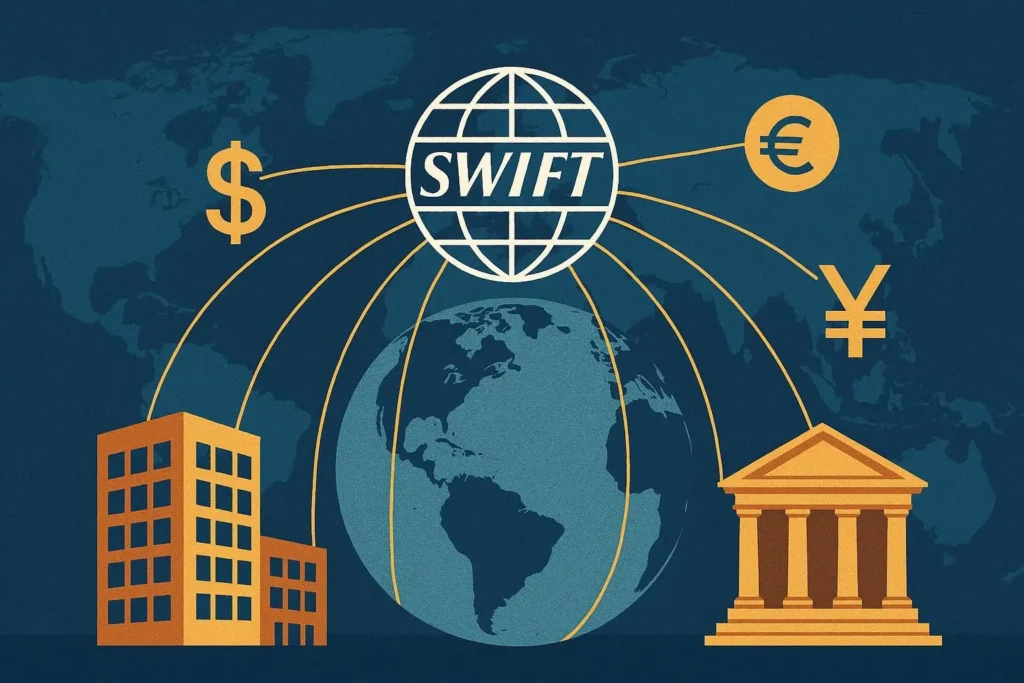
SWIFT Global Finance, Every day, trillions of dollars move across borders to pay for goods, services, investments, energy supplies, and countless other transactions that keep the global economy running. Behind many of these payments is a system that most people have never used directly but that has become one of the most important infrastructures in modern finance: SWIFT.
Whether a company in Germany is paying a supplier in China, an investor in Japan is purchasing American assets, or a bank in Brazil is settling transactions with partners in Europe, chances are that SWIFT plays a role in facilitating communication between financial institutions.
Over the past five decades, SWIFT has evolved from a technical messaging network into one of the pillars of the international financial system. It is often described as the nervous system of global banking because it enables secure and standardized communication between thousands of financial institutions across the world.
Today, SWIFT is more than a payment network. It is a strategic asset, a geopolitical tool, and a symbol of the interconnected global economy. Understanding how SWIFT became the backbone of global finance provides valuable insight into the way money moves around the world and how economic power is exercised in the twenty-first century.
What Is SWIFT?
SWIFT stands for the Society for Worldwide Interbank Financial Telecommunication. Founded in 1973 and headquartered in Belgium, SWIFT was created to solve a growing problem in international banking.
Before SWIFT, banks relied on telex systems to communicate payment instructions. These methods were slow, inconsistent, and vulnerable to errors. Different banks used different formats, creating inefficiencies and increasing the risk of mistakes.
SWIFT introduced a standardized messaging system that allowed banks to exchange financial information securely and efficiently. Instead of moving money itself, SWIFT sends payment instructions between institutions.
Think of SWIFT as the global postal service for banks. The network does not physically transport money; it delivers verified messages that tell banks how and where funds should move.
Today, SWIFT connects more than 11,000 financial institutions across over 200 countries and territories, making it one of the largest financial communication networks in the world.
Official Website: https://www.swift.com
Why SWIFT Was Revolutionary
The success of SWIFT was not accidental. It solved several critical problems simultaneously.
Standardization
SWIFT introduced common formats for financial messages. Every participating institution could understand and process instructions using the same language.
This standardization dramatically reduced errors and improved efficiency.
Security
Financial transactions require trust. SWIFT developed secure communication protocols that became industry standards.
Banks gained confidence that payment instructions were authentic and protected from unauthorized interference.
Speed
Compared with older systems, SWIFT significantly accelerated international communications.
What once took days could often be completed in hours.
Scalability
As international trade expanded, SWIFT scaled alongside it. The network’s architecture enabled rapid growth without sacrificing reliability.
The Rise of Globalization and SWIFT’s Expansion
The late twentieth century witnessed unprecedented globalization.
Manufacturing supply chains stretched across continents. International investments surged. Trade volumes exploded. Capital became increasingly mobile.
These developments created a growing need for reliable cross-border financial communication.
SWIFT was uniquely positioned to meet this demand.
During the 1980s and 1990s, thousands of financial institutions joined the network. As membership expanded, SWIFT became more valuable because each new participant increased the utility of the system.
Economists call this phenomenon the network effect.
The more institutions connected to SWIFT, the more indispensable it became.
By the early 2000s, SWIFT had become deeply embedded in global finance.
How SWIFT Works
A common misconception is that SWIFT transfers money directly.
In reality, SWIFT transmits messages between banks.
Consider a customer in the United Kingdom sending money to a recipient in Singapore.
- The sending bank creates a SWIFT message.
- The message identifies the recipient bank.
- Payment instructions are transmitted securely.
- Correspondent banks may facilitate settlement.
- Funds arrive in the recipient account.
SWIFT provides the communication layer while various banking relationships handle actual settlement.
This distinction is important because it explains why SWIFT has become so powerful despite not technically moving money itself.
The Network Effect That Created a Global Standard
One of the biggest reasons for SWIFT’s dominance is the network effect.
Once enough banks joined the platform, participation became almost mandatory for institutions engaged in international finance.
A bank disconnected from SWIFT would face major challenges conducting international business.
This self-reinforcing cycle helped SWIFT become the global standard.
Today, competing systems exist, but none possess the same level of international adoption.
The result is a financial ecosystem heavily dependent on SWIFT’s infrastructure.
SWIFT and International Trade

Modern global trade would be difficult to imagine without SWIFT.
International commerce depends on trust and coordination between buyers, sellers, banks, insurers, and logistics providers.
SWIFT facilitates communication for:
- Trade finance
- Letters of credit
- Cross-border payments
- Securities transactions
- Foreign exchange operations
Every day, millions of messages flow through the network supporting economic activity across industries.
From energy shipments to electronics manufacturing, SWIFT helps ensure that financial transactions can be executed securely and efficiently.
SWIFT’s Role in Financial Stability
Global financial systems require reliability.
A major disruption in financial messaging could create uncertainty across markets and institutions.
SWIFT’s infrastructure has become a critical component of financial stability because it provides:
- Consistent communication standards
- High operational reliability
- Secure data transmission
- Global interoperability
Central banks, regulators, and financial institutions depend on these capabilities to maintain confidence in international markets.
SWIFT as a Geopolitical Tool
Perhaps the most fascinating aspect of SWIFT’s evolution is its geopolitical significance.
As the network became essential to global finance, access to SWIFT gained strategic importance.
Countries and institutions disconnected from SWIFT can face significant obstacles conducting international business.
This reality transformed SWIFT from a financial utility into a geopolitical instrument.
Economic sanctions increasingly leverage financial infrastructure to influence state behavior.
The ability to restrict access to global financial networks can exert enormous pressure without military intervention.
Russia, Sanctions, and the Global Debate
The geopolitical importance of SWIFT became especially visible after sanctions imposed on Russia following the Ukraine conflict.
Restrictions affecting Russian financial institutions highlighted how deeply integrated SWIFT is within the global economy.
The episode sparked global discussions about:
- Financial sovereignty
- Alternative payment systems
- Multipolar finance
- Economic resilience
- Digital currency development
Many countries began exploring ways to reduce dependence on existing financial infrastructure.
This marked a turning point in the conversation about the future architecture of international finance.
China’s Alternative Vision
China has invested heavily in developing alternative financial infrastructure.
One example is the Cross-Border Interbank Payment System (CIPS), designed to facilitate international transactions involving the Chinese yuan.
While CIPS remains much smaller than SWIFT, it reflects broader efforts to diversify global financial networks.
The emergence of alternative systems does not necessarily signal the end of SWIFT. Instead, it suggests a future where multiple payment infrastructures coexist.
This trend mirrors larger geopolitical shifts toward a more multipolar world.
Digital Currencies and the Future of SWIFT
Central Bank Digital Currencies (CBDCs) are creating new possibilities for international payments.
Countries including China, members of the European Union, and others are exploring digital currency initiatives.
These technologies could eventually alter aspects of cross-border finance by enabling faster settlement and greater efficiency.
SWIFT has responded by actively researching and testing interoperability solutions involving digital assets and CBDCs.
Rather than resisting innovation, SWIFT is positioning itself as a bridge between traditional finance and emerging digital systems.
This adaptability may prove crucial for maintaining relevance in the decades ahead.
Challenges Facing SWIFT
Despite its dominance, SWIFT faces several challenges.
Geopolitical Fragmentation
Increasing geopolitical competition could encourage the development of regional alternatives.
Technological Innovation
Blockchain-based payment systems continue to evolve.
Cybersecurity Threats
As a critical financial infrastructure provider, SWIFT remains a high-value target for cyberattacks.
Regulatory Complexity
Operating across hundreds of jurisdictions requires constant adaptation to changing regulations.
How SWIFT addresses these challenges will influence the future of global finance.
Why SWIFT Still Matters
Even amid rapid technological change, SWIFT remains central to the international financial system.
Its advantages include:
- Global reach
- Trusted standards
- Institutional acceptance
- Regulatory integration
- Operational reliability
Building a replacement would require not only advanced technology but also global trust, coordination, and adoption.
These factors explain why SWIFT continues to occupy such a dominant position despite growing competition.
The Future of Global Financial Infrastructure
The next decade could reshape international finance.
Emerging technologies, geopolitical competition, digital currencies, and shifting economic power are all influencing the evolution of payment networks.
The most likely outcome is not the disappearance of SWIFT but the emergence of a more complex financial ecosystem where multiple systems interact.
SWIFT’s future may depend on its ability to remain a neutral, efficient, and technologically advanced platform in an increasingly fragmented world.
If it succeeds, it will continue serving as a cornerstone of global finance.
If alternative systems gain significant traction, the world could witness the development of a more decentralized financial architecture.
Either way, SWIFT will remain central to the story.
Conclusion
How SWIFT became the backbone of global finance is ultimately a story about standardization, trust, and network effects. What began as a solution to inefficient banking communications evolved into one of the most important infrastructures supporting the global economy.
Today, SWIFT facilitates financial communication between thousands of institutions, underpins international trade, and influences geopolitical strategy. Its role extends far beyond banking, touching nearly every aspect of modern economic activity.
As the world enters an era of digital currencies, technological disruption, and shifting geopolitical power, SWIFT faces both challenges and opportunities. Yet its history demonstrates a remarkable ability to adapt and evolve.
Whether the future brings greater integration or increased fragmentation, understanding SWIFT is essential for understanding how global finance operates in the twenty-first century.