AI and the Global Power Shift: How Artificial Intelligence Is Redefining World Leadership
The Next Great Transformation
Every era has been defined by a technology that reshaped the balance of power. The Industrial Revolution elevated nations that mastered mechanized production. The nuclear age transformed military strategy and geopolitical influence. Today, Artificial Intelligence (AI) is emerging as the defining technology of the 21st century, with the potential to alter the global order more profoundly than any innovation since the internet.
AI is no longer confined to research laboratories or technology companies. It is becoming the engine behind economic growth, military modernization, scientific discovery, and political influence. As governments and corporations invest billions into AI development, a new global power shift is unfolding—one that will determine which nations lead and which struggle to keep pace in the decades ahead.
Power in the Age of Intelligence
Historically, global power has been measured through military strength, industrial output, natural resources, and geographic influence. While these factors remain important, the digital era has introduced a new strategic asset: intelligence at scale.
AI enables governments and organizations to process enormous volumes of information, automate complex tasks, and make decisions with unprecedented speed. In this environment, data, computing power, advanced algorithms, and highly skilled talent have become critical national resources.
The nations that successfully combine these resources are positioning themselves to dominate future industries, shape international standards, and influence global decision-making.
The New Geopolitical Race
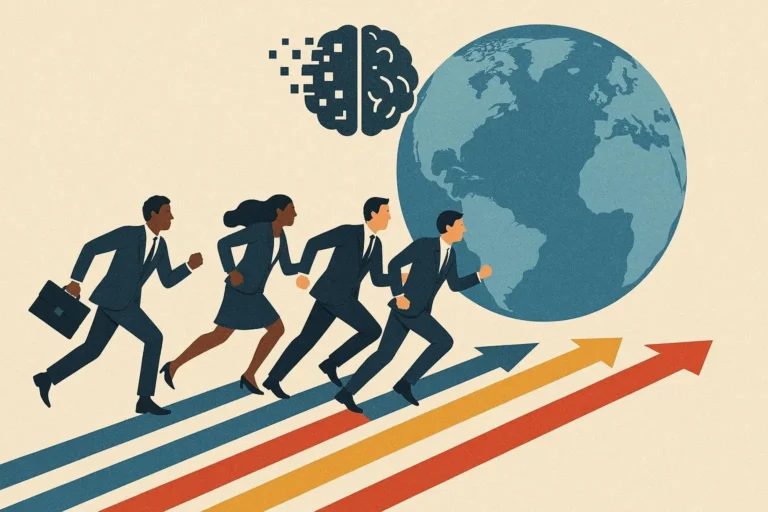
The competition for AI leadership has become one of the most significant geopolitical contests of our time.
The United States currently maintains advantages through its innovation ecosystem, leading technology companies, world-renowned universities, and venture capital networks. Meanwhile, China has aggressively expanded its AI ambitions through national strategies, large-scale investments, and access to vast datasets.
Beyond these two powers, countries such as the United Kingdom, India, Japan, South Korea, Germany, and the United Arab Emirates are investing heavily in AI research and digital infrastructure to secure their place in the emerging technological landscape.
This race is not simply about developing smarter machines. It is about shaping the future rules of the global economy, digital governance, cybersecurity, and international influence.
Economic Power and the AI Divide
Artificial Intelligence is expected to contribute trillions of dollars to the global economy over the coming decades. Businesses are using AI to automate operations, improve productivity, optimize supply chains, and create entirely new products and services.
However, the benefits may not be evenly distributed.
Countries with strong technological ecosystems are likely to capture a disproportionate share of AI-driven growth. Nations lacking digital infrastructure, research capabilities, or skilled workforces risk falling behind, creating a widening “AI divide” between technological leaders and followers.
This emerging gap raises concerns about a new form of digital dependency, where countries rely heavily on foreign AI platforms, cloud infrastructure, and technology providers for critical services.
AI and the Future of Military Power
Military superiority has long been a cornerstone of geopolitical influence, and AI is rapidly transforming modern defense strategies.
AI-powered surveillance systems, autonomous drones, predictive intelligence platforms, and cyber-defense technologies are changing how nations prepare for and conduct military operations. Future conflicts may be determined as much by algorithms and data superiority as by traditional weapons systems.
While these advancements offer strategic advantages, they also introduce serious risks. Autonomous weapons, AI-driven cyberattacks, and algorithmic decision-making in conflict zones raise difficult ethical and security questions that governments have yet to fully address.
As AI capabilities advance, international cooperation and regulatory frameworks will become increasingly important to prevent destabilizing arms races and unintended escalation.
The Battle for Information
In today’s interconnected world, influence is increasingly exercised through information rather than territory.
AI-driven content generation, recommendation algorithms, and data analytics enable governments, companies, and organizations to shape public narratives at unprecedented scale. These technologies can improve communication and education, but they can also amplify misinformation, manipulate public opinion, and influence democratic processes.
Control over digital information ecosystems is becoming a strategic asset. Countries that effectively manage information flows may gain significant advantages in diplomacy, political influence, and economic competitiveness.
The struggle for influence in the AI era may therefore be fought not only on battlefields and in boardrooms but also across digital platforms and information networks.
Governance, Ethics, and Global Responsibility
The rise of AI presents one of the greatest governance challenges of the modern era.
Questions surrounding transparency, accountability, privacy, bias, and human oversight remain unresolved. Different countries are pursuing different regulatory approaches, reflecting contrasting political systems and cultural values.
The challenge for policymakers is to encourage innovation while ensuring that AI remains aligned with human interests and democratic principles.
Without international cooperation, the pursuit of technological advantage could outpace ethical safeguards, creating risks that transcend national borders.
Toward a Multipolar Technological World
One of the most significant consequences of AI is the emergence of a more complex distribution of power.
Governments are no longer the sole actors shaping global affairs. Technology companies now control vast digital ecosystems, cloud infrastructure, and AI platforms that influence billions of people worldwide. In some areas, their reach rivals that of nation-states.
As a result, the future international order may be defined not only by competition among countries but also by interactions between governments, corporations, research institutions, and global technology networks.
This shift challenges traditional concepts of sovereignty and raises important questions about who ultimately controls the technologies shaping society.
Conclusion
Artificial Intelligence is rapidly becoming one of the most important drivers of global power in the 21st century. Its impact extends far beyond technology, influencing economics, security, governance, and international relations.
The nations, institutions, and companies that lead in AI development will play a significant role in shaping the future world order. At the same time, the choices made today regarding regulation, ethics, and international cooperation will determine whether AI becomes a force for shared prosperity or increased division.
The global power shift is already underway. The real challenge is ensuring that the future it creates benefits humanity as a whole rather than a select few.
Note: AI is not simply changing how we work—it is changing how power itself is created, exercised, and distributed across the world. Understanding this transformation is essential for policymakers, businesses, and citizens alike.