Undersea Internet Cables: The Hidden Infrastructure of Global Power
Introduction: The Internet Runs Underwater
When people think about the internet, they imagine satellites orbiting Earth, cloud servers, Wi-Fi routers, and data centers. Yet the vast majority of global internet traffic does not travel through space. Instead, it moves through thousands of kilometers of fiber-optic cables lying silently on the ocean floor.
More than 95% of international data—including financial transactions, military communications, cloud computing services, video calls, social media activity, and AI workloads—travels through undersea internet cables. These cables form the invisible nervous system of the global economy.
In an era defined by geopolitical competition, digital sovereignty, artificial intelligence, and economic interdependence, undersea cables have become strategic assets comparable to oil pipelines, shipping lanes, and energy grids. Nations and technology giants are investing billions of dollars to secure these critical arteries of global connectivity.
The battle for influence beneath the oceans may shape the future of international power as profoundly as conflicts on land, sea, air, and space.
What Are Undersea Internet Cables?
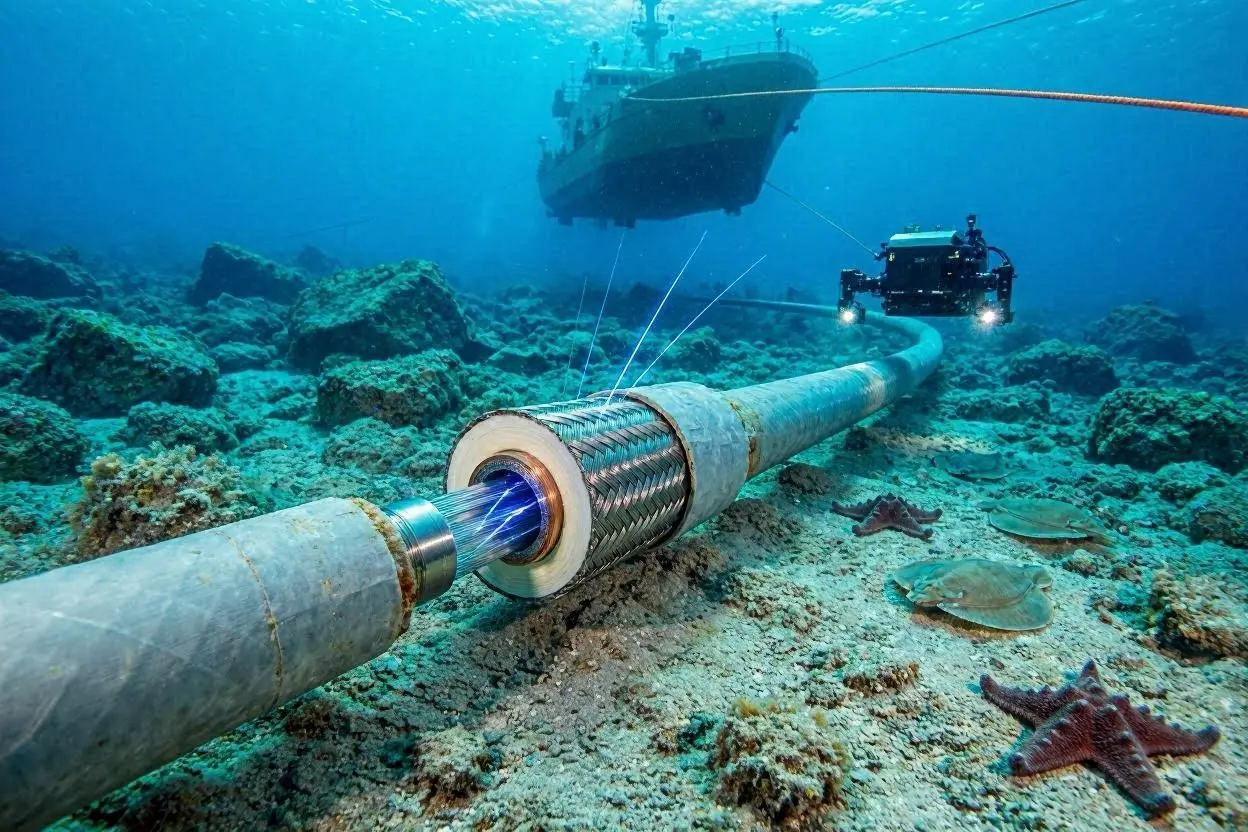
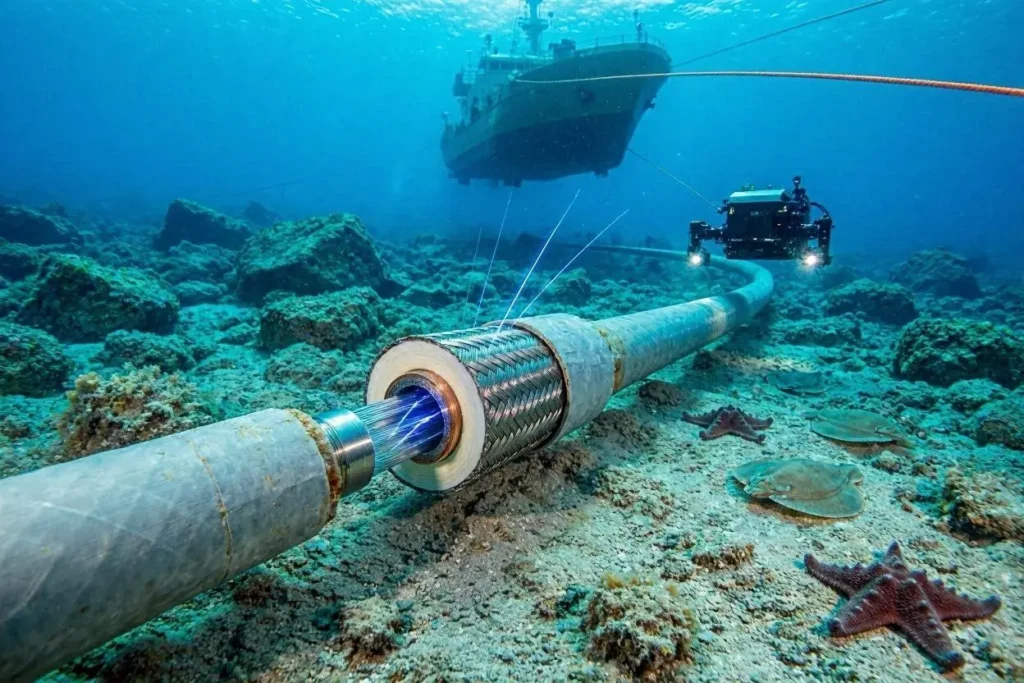
Undersea internet cables, also known as submarine communications cables, are fiber-optic systems laid along the seabed to transmit data between continents.
A modern cable consists of:
- Fiber-optic strands carrying light signals
- Protective steel layers
- Waterproof insulation
- Power conductors
- Reinforced outer shielding
Despite their strategic importance, many deep-ocean cables are only slightly thicker than a garden hose.
These systems connect landing stations located on coastlines around the world. Once data reaches a landing station, terrestrial networks distribute it to cities, businesses, cloud providers, and users.
The first transatlantic telegraph cable was successfully completed in 1858. Today, modern submarine cable systems can transmit hundreds of terabits per second, supporting billions of connected devices worldwide.
Why Undersea Cables Matter More Than Satellites
Popular culture often portrays satellites as the backbone of global communications. In reality, satellites carry only a tiny fraction of global internet traffic.
The reasons are straightforward:
Speed
Fiber-optic cables provide significantly lower latency than satellites.
Capacity
Modern cables can carry enormous amounts of data simultaneously, far exceeding satellite capacity.
Cost Efficiency
Transmitting data through cables is generally cheaper than satellite communications.
Reliability
Submarine networks provide stable, continuous connectivity essential for financial markets, cloud computing, and critical infrastructure.
Even as satellite internet systems expand, undersea cables remain the foundation of the digital world.
The Geography of Global Connectivity
The global submarine cable network reflects both economic activity and geopolitical power.
Major hubs include:
- United States
- United Kingdom
- France
- Singapore
- Japan
- India
- United Arab Emirates
Strategic chokepoints have emerged where multiple cable systems converge:
The English Channel
One of the world’s most concentrated cable corridors.
The Mediterranean
A critical route connecting Europe, Africa, and Asia.
The Red Sea
A narrow but essential pathway linking Europe with Asian markets.
The South China Sea
A central artery for East Asian digital traffic.
The Strait of Malacca
One of the world’s most important maritime and digital bottlenecks.
Disruption at any of these locations can affect global connectivity, trade, and financial systems.
Big Tech’s Quiet Takeover of the Oceans
Historically, telecommunications companies owned most submarine cable infrastructure.
That reality has changed dramatically.
Today, major technology corporations are among the largest investors in global cable systems:
- Meta
- Microsoft
- Amazon
These companies require massive bandwidth to support:
- Cloud computing
- Artificial intelligence workloads
- Global content delivery
- Streaming services
- Enterprise infrastructure
Google alone has invested in multiple transoceanic cable projects connecting North America, Europe, Asia, and Africa.
This shift raises important questions:
- Are technology companies becoming infrastructure powers?
- Who controls the digital arteries of the world?
- What happens when private corporations own critical global communications systems?
The ownership of undersea cables increasingly reflects the concentration of digital power in the hands of a small number of technology giants.
Undersea Cables and Geopolitical Competition
Submarine cables are no longer merely commercial infrastructure.
They are geopolitical assets.
Governments increasingly view cable networks through the lens of national security.
United States
Washington considers cable infrastructure vital to economic and military resilience.
China
Beijing has invested heavily in global telecommunications infrastructure through state-backed firms and international partnerships.
Europe
The European Union seeks greater digital sovereignty and reduced dependence on foreign-controlled infrastructure.
India
India aims to become a major digital hub connecting Europe, the Middle East, Africa, and Asia.
The competition over submarine networks mirrors broader struggles for technological leadership and strategic influence.
The Security Risks Beneath the Sea
Undersea cables face a wide range of threats.
Accidental Damage
Fishing trawlers and ship anchors account for many cable disruptions worldwide.
Natural Disasters
Earthquakes, underwater landslides, and volcanic activity can sever multiple cables simultaneously.
Espionage
Intelligence agencies have long recognized submarine cables as valuable sources of information.
Historical reports suggest several governments have developed capabilities to monitor or intercept communications passing through cable networks.
Sabotage
A growing concern is the deliberate targeting of critical infrastructure.
Recent incidents involving energy pipelines and communication systems have increased attention on the vulnerability of underwater assets.
Because repairing damaged cables often requires specialized ships and can take weeks, disruptions can have significant economic consequences.
The Economic Value of Submarine Infrastructure
The global economy depends on continuous data flows.
Every day, submarine cables support:
- International banking transactions
- Global stock markets
- Supply chain coordination
- E-commerce platforms
- Cloud services
- Artificial intelligence systems
Financial markets are particularly dependent on ultra-low-latency connections.
Milliseconds can determine competitive advantage in high-frequency trading.
A major cable outage can cost economies millions of dollars per day through reduced connectivity, slower transactions, and disrupted services.
The digital economy is only as resilient as the infrastructure supporting it.
AI, Cloud Computing, and the New Cable Boom
Artificial intelligence is accelerating demand for global data transmission.
Training large AI models requires:
- Massive datasets
- Distributed computing resources
- Cross-border data movement
At the same time, cloud computing continues to expand worldwide.
As AI adoption increases, demand for high-capacity submarine networks is expected to grow substantially.
This has triggered a new wave of cable construction connecting:
- North America and Europe
- Asia and the Middle East
- Africa and global digital markets
- Emerging technology hubs
The future of AI may depend as much on physical infrastructure as on algorithms.
The Emerging Battle for Digital Sovereignty
Many nations now recognize that control over data routes affects national security, economic competitiveness, and political autonomy.
Digital sovereignty initiatives focus on:
- Domestic data centers
- National cloud infrastructure
- Independent cable networks
- Secure communications systems
Countries increasingly seek to reduce dependence on external actors for critical digital infrastructure.
This trend may reshape the architecture of the global internet in the coming decades.
The Future of the Global Internet
Several developments are likely to define the next generation of submarine infrastructure:
Increased Redundancy
Countries and companies will build additional routes to reduce vulnerability.
Arctic Routes
Climate change is creating opportunities for new cable corridors through Arctic waters.
Higher Capacity Systems
Advances in fiber-optic technology will dramatically increase transmission capabilities.
Greater Security Investment
Governments are expected to expand monitoring and protection of underwater infrastructure.
Integration with AI Networks
Future cable systems may be designed specifically to support AI-intensive computing environments.
The internet’s physical backbone will become increasingly important as digital activity continues to expand.
Conclusion: Power Beneath the Waves
Undersea internet cables are among the most important yet least visible components of modern civilization.
They carry the world’s communications, support global trade, enable financial markets, power cloud computing, and sustain the digital economy.
As geopolitical competition intensifies and artificial intelligence transforms society, control over these underwater networks is becoming a strategic priority for governments and corporations alike.
The future balance of global power may not be determined solely by armies, navies, or satellites.
It may also depend on the thousands of kilometers of fiber-optic cables resting quietly on the ocean floor—out of sight, but increasingly central to the world’s economic and geopolitical future.
References & Further Reading
- TeleGeography Submarine Cable Map – https://www.submarinecablemap.com
- International Telecommunication Union (ITU) – https://www.itu.int
- International Cable Protection Committee (ICPC) – https://www.iscpc.org
- OECD Digital Economy Reports – https://www.oecd.org/digital
- U.S. Congressional Research Service: Undersea Cables and National Security
- NATO Strategic Communications Reports on Critical Undersea Infrastructure
- World Bank Digital Development Research
- European Commission Digital Infrastructure Reports
- Brookings Institution Research on Global Connectivity
- Council on Foreign Relations Analysis of Digital Geopolitics